Introduction
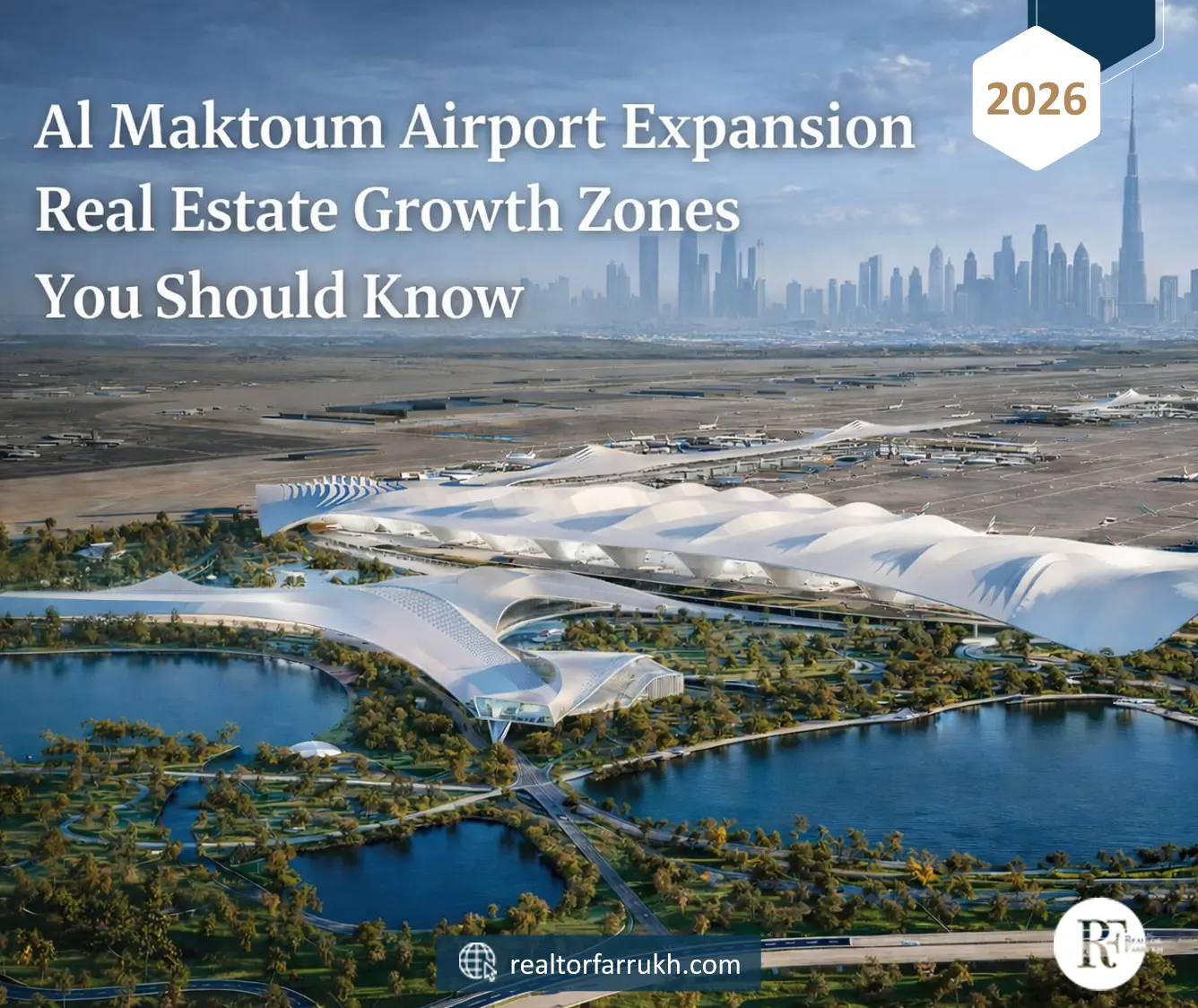
Al Maktoum International Airport (DWC) in Dubai South is undergoing a record‑breaking expansion backed by roughly AED 128 billion ($35 billion). When complete, the airport will accommodate around 260 million passengers a year and boast five runways, four terminal buildings, and more than 400 aircraft gates. This colossal project isn’t simply about aviation; it is creating an aerotropolis that will house more than a million people and fuel the Al Maktoum Airport real estate growth story. As the emirate’s development focus shifts southward, Dubai South is rapidly transforming from a quiet outlying district into a thriving hub. For anyone tracking Dubai off‑plan real estate trends, the message is clear: opportunity is orbiting around the new airport. As a Dubai-based real estate agent working closely with off-plan buyers, I’ve seen a clear shift in client interest toward Dubai South since the DWC expansion plans were officially confirmed.
Key points:
- DWC is slated to become the world’s largest airport with a capacity of 260 million passengers.
- The government has invested about AED 128 billion in the project.
- Dubai South’s master plan supports over one million future residents.
- Demand for homes, jobs, and services is shifting south toward the Al Maktoum orbit.
DWC Expansion: A Catalyst for Real Estate Growth
The scale of the DWC expansion is unprecedented. Spanning roughly 70 sq km, the new airport will be five times the size of Dubai International Airport. Its design includes five runways and four terminals, effectively creating a self‑contained “airport city” at the heart of Dubai South. Officials expect the project to create around one million jobs across aviation, logistics, hospitality, and retail. These jobs, coupled with government planning for housing, schools, and healthcare, are driving both population growth and sustained demand for property in nearby communities. In real buyer discussions, most enquiries are now coming from professionals and families planning 5-10 years, not short-term speculators. Strong state backing and clear long‑range planning differentiate this expansion from speculative hype. Dubai South is built to last.
Why it matters:
- Unmatched scale: DWC’s capacity of 260 million passengers and five runways signals long‑term economic activity.
- Job creation: The project is forecast to generate roughly one million jobs, increasing demand for housing and services.
- Integrated master plan: Dubai South combines residential districts, logistics hubs,s and commercial zones, with infrastructure and amenities already in place.
- Investor confidence: Government support and phased development reduce speculation and underpin sustained growth.
Emerging Property Hotspots Near Al Maktoum Airport
Several districts around DWC are evolving into property hotspots. Dubai South Residential District, including communities such as The Pulse and South Bay, offers affordable apartments, townhouses, and villas with modern amenities. Nearby Emaar South features an 18‑hole golf course and a mix of townhouses and off‑plan villas in Dubai. To the north, Expo City Dubai legacy site of Exp2020, has been reimagined as a mixed‑use innovation hub with offices, attractions, and residences. Established areas such as Dubai Investments Park (DIP) and Jebel Ali are set to benefit from improved highways and planned metro links that cut travel time and increase demand for both housing and commercial space. From my on-ground experience, communities like Dubai South Residential District and Emaar South are shortlisted mainly for space, future connectivity, and price stability compared to central Dubai. Even communities slightly farther afield-Al Furjan, Jumeirah Village Circle (JVC), and Town Square-are seeing new launches and rising interest as developers respond to the demand for reasonably priced homes within commuting distance of the airport.
Hotspot highlights:
- Dubai South & Emaar South: Offer modern, master‑planned neighborhoods with townhouses and villas, ample green space, and easy airport access.
- Expo City Dubai: A sustainable business and residential hub built on the Expo 2020 legacy.
- DIP & Jebel Ali: Benefit from upgraded roads and planned metro links, attracting logistics and aviation businesses.
- Outer communities: Areas like Al Furjan, JVC, and Town Square provide larger homes at relatively lower prices, appealing to middle‑income buyers.
Dubai South Property Market Outlook 2025
Property activity in Dubai South has surged. Real estate transactions and new project launches increased sharply in 2024 and 2025. Market reports show property prices have jumped around 20-25 % since the airport expansion plans were confirmed, while rental rates rose by roughly 20 % in 2025 alone. This rapid appreciation reflects both investor and resident interest in the area. Importantly, the buyer profile is evolving: what began as an investor‑driven market is now attracting families, aviation professionals, and service workers seeking larger homes and proximity to employment. Many tenants I work with are now transitioning into ownership here, driven by rising city rents and the availability of well-planned off-plan townhouses and apartments. Developers are responding with numerous projects geared toward first‑time buyers and off‑plan townhouses in Dubai that combine affordability with parks, schools, and retail.
Infrastructure improvements support this growth. Major highways like Emirates Road (E611) and Sheikh Mohammed Bin Zayed Road have been expanded to enhance connectivity. Plans to extend the Dubai Metro via the Blue Line, along with Route 202,0 already reaching near Expo/DubaSouth, promise better public transport. Analysts anticipate continued property value growth over the next five to ten years, linked to the roll‑out of infrastructure and population growth.
Market snapshot:
- Rising values: Property prices and rents in Dubai South have experienced double‑digit growth.
- End‑user momentum: More families and professionals are buying homes, adding stability to the market.
- Infrastructure gains: Expanded highways and planned metro extensions improve accessibility and enhance property appeal.
- Long‑term outlook: Analysts expect steady growth over the next 5–10 years, tied to infrastructure roll‑out and population expansion.
Summary & Investment Tips
This perspective is based on active client enquiries, project launches, and transaction trends I monitor daily as part of my real estate practice in Dubai. The Al Maktoum Airport expansion is reshaping Dubai's urban geography. Areas surrounding DWC are transforming into vibrant residential and commercial zones backed by significant government investment and a clear long‑term vision. However, the timeline is multi‑decadal. The airport’s first major phase isn’t expected to open until 2032, and full relocation of airline operations may extend into the late 2030s. Investors and homebuyers should therefore align expectations with this phased development, focusing on fundamentals like transport links, community amenities, and reputable developers. Early movers who choose wisely and adopt a long‑term perspective stand to benefit as Dubai South matures into the city’s next powerhouse.
Investment tips:
- Think long‑term: The DWC expansion will unfold in phases up to 2032 and beyond, so patience is key.
- Pick the right community: Opt for projects in well‑planned neighborhoods with existing or guaranteed infrastructure.
- Stay informed: Monitor infrastructure updates-new roads or metro lines often precede property value jumps.
- Diversify wisely: Consider new villa projects in Dubai or new apartment projects in Dubai to spread risk across different property types.
FAQs
Q1. Where is Al Maktoum International Airport (DWC) located?
Al Maktoum International Airport sits in Dubai South, roughly 40 km south of central Dubai and near the Dubai and Abu Dhabi border. It has direct access to major highways like E311 and E611.
Q2. When will the Al Maktoum Airport expansion be completed?
The expansion is being rolled out in phases. The first significant phase is expected to open to passengers by 2032. Full completion, including all terminals and runways, will likely extend into the late 2030s.
Q3. What are the property hotspots near Al Maktoum Airport?
Key hotspots include the Dubai South Residential District, Emaar South, Expo City Dubai, Dubai Investments Park, Jebel Ali, and nearby communities like Al Furjan, J, V C and Town Square. Each offers a mix of apartments, townhouses, and villas at relatively affordable prices.
Q4. Is investing in Dubai South property in 2025 a good idea?
Investing in Dubai South can be rewarding if you have a medium‑ to long‑term outlook. Prices remain lower than in many parts of Dubai, yet are rising as the area gains popularity. Rental yields have been strong due to demand from new businesses and residents. Choose well‑planned projects and be patient.
Q5. Will Al Maktoum (DWC) eventually replace Dubai International Airport (DXB)?
That is the long‑term plan. The government envisions DWC becoming Dubai’s main airport in the next decade. DXB will remain operational in the near term, and a complete handover will occur only when DWC’s capacity and facilities are fully developed.
Q6. How is the DWC expansion impacting property prices in Dubai?
The expansion is already influencing property prices and development patterns. Areas closest to the airport, Dubai South and its surroundings, have seen values climb faster than the city average. Developers are launching more projects in outer districts, diversifying Dubai’s real estate landscape.