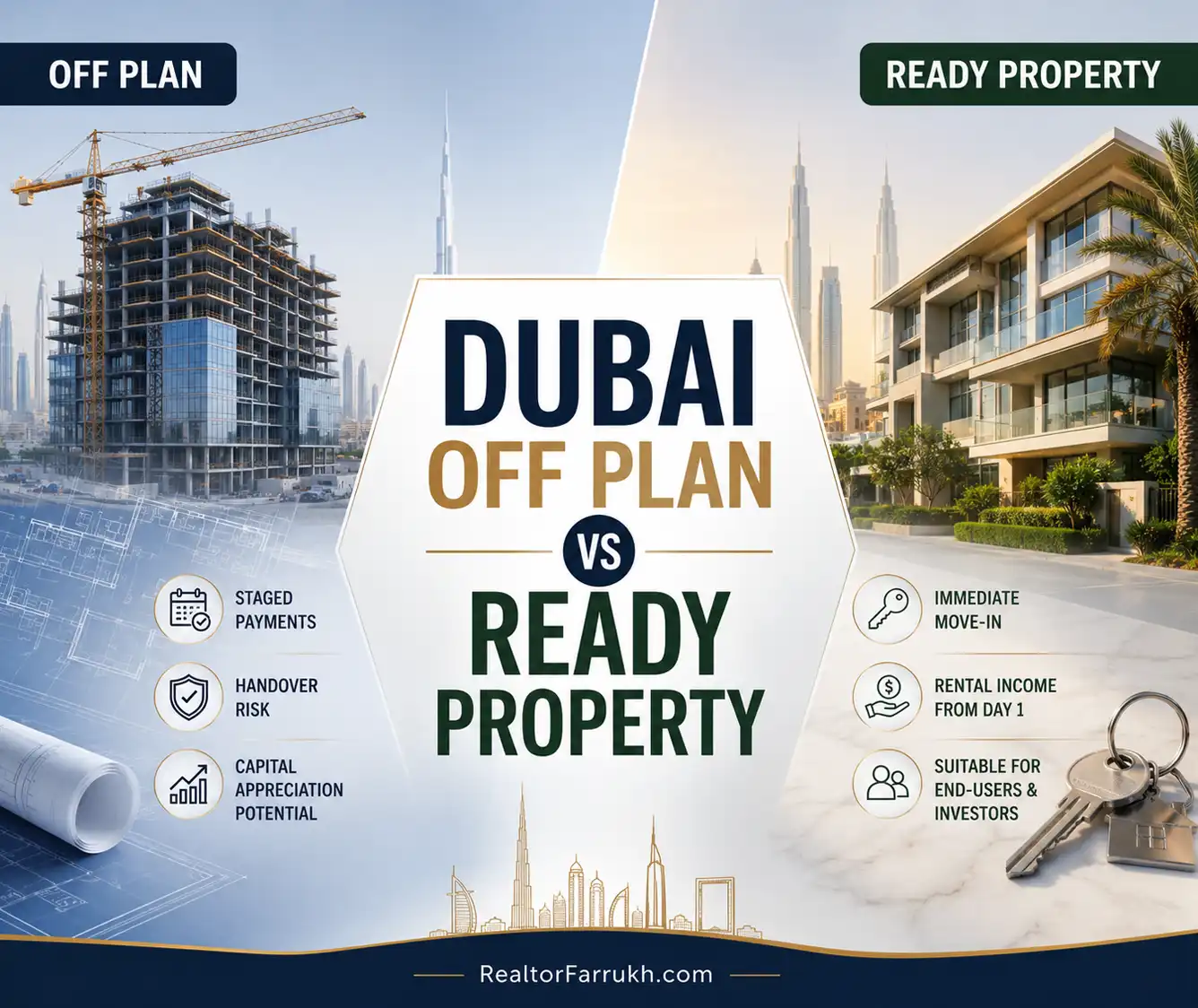
If you are deciding off plan vs ready property Dubai, the practical answer is this: buy off-plan if you are comfortable waiting, prefer staged payments, and care more about future use or capital growth than income today; buy ready if you want immediate use, earlier rental timing, and a property you can verify today through title, status, rent, and service-charge checks. Dubai Land Department separates off-plan and ready registrations, and it gives buyers different tools to check project progress, title deeds, rents, and service charges before they commit.
Quick Answer
Off-plan usually suits the buyer whose biggest priority is cash-flow shape. In Dubai, off-plan sales are registered through the provisional register via Oqood, and DLD’s own first-time buyer program highlights flexible payment plans for off-plan units. That makes off-plan more suitable for buyers who do not need the home or the rental cash flow to start immediately. It is typically the stronger fit for patient investors targeting capital appreciation and future end users who can wait for handover.
Ready property usually suits the buyer whose biggest priority is certainty. A completed unit can sit inside the normal completed-sale and title-deed framework, can be checked through DLD property-status and title-deed tools, and can be benchmarked against today’s rental index and approved service charges. That makes ready property more suitable for immediate occupancy, rental income sooner, and lower execution risk at the point of purchase.
How Off Plan and Ready Really Differ
The real difference is not brochure versus building. It is when your money goes out, when the asset starts working for you, and how much can be verified today. Dubai’s official systems make that distinction very clear: DLD keeps separate registration types for ready and off-plan, separate project-status data, separate rent data, and service-charge records for jointly owned property.
| Decision point | Off-plan | Ready property |
| Payment shape | Usually staged during construction, often with more spread-out commitments | Usually more front-loaded around purchase closing, even if debt is used |
| Income timing | No meaningful rental income until completion, handover, and leasing | Can potentially be occupied or leased on a completed asset much sooner |
| What you can verify now | Project completion %, escrow, project details, and developer execution | Title deed validity, property status, current condition, service charges, and rent benchmarks |
| Appreciation logic | Better if your thesis is “buy earlier, wait, and let development progress create value” | Better if your thesis is “buy a known asset and let current usability support the hold” |
| Main blind spot | Handover risk and execution mismatch | Ongoing costs and overpaying for current-market certainty |
This comparison is a buyer-side synthesis of DLD’s off-plan registration and project-tracking tools, DLD’s completed-property verification and rent/service-charge tools, and current market research showing that off-plan remains dominant while secondary-market conditions can still soften.
Upfront cost and payment shape
Off-plan appeals to buyers who want to stage the commitment instead of compressing most of the cash event into one purchase moment. DLD’s first-time buyer program explicitly refers to flexible payment plans for off-plan units, and DLD’s provisional-sale process shows that off-plan purchases are handled differently from completed property transfers because the unit is sold before full completion and moved through the Oqood/provisional-register route.
Ready property changes the shape of the decision because you are buying a completed asset, not a promise that is still moving through construction milestones. Banks in the UAE also distinguish between finance for ready property and separate under-construction or off-plan products, which is another practical sign that ready and off-plan are not the same cash-flow decision. In plain English, ready property usually asks for more certainty up front, while off-plan usually asks for more patience over time.
Move-in timing and income timing
This is where serious buyers should be brutally honest. If you need the property to serve you soon as a home or an income asset, ready property has the advantage because the unit is already in the completed-property ecosystem: you can verify title, check property status, and benchmark rent using DLD’s rental tools. Off-plan, by definition, lives in the project-status world until the project is completed and handed over.
That is why rental income suitability is very different. Ready property is usually more suitable for the investor who wants a shorter path to leasing because DLD’s Rental Index and Smart Rental Index exist to calculate average rental levels and fair increases on active market stock. Off-plan can still be a strong investment, but the rental story starts later and depends on successful completion, handover, and the leasing market you inherit at that time.
Exit flexibility and resale logic
Ready property is generally easier to underwrite for resale because buyers can judge a real, present asset. They can check the title deed, property status, current rent evidence, and approved service charges, then compare that against actual area transactions and rent data through DLD open data. In other words, the resale logic for ready property is grounded in today’s asset and today’s evidence.
Off-plan resale logic is more conditional. Your exit depends more on project stage, how much has been paid, how attractive the launch remains versus competing supply, and whether market sentiment is still supporting contract transfers and secondary appetite. Savills reported that off-plan accounted for 72% of Dubai residential transactions in Q1 2026, but it also noted that secondary-market activity declined significantly in March and mortgage activity reduced, while CBRE said price and rental growth were moderating and future deliveries were making some investors more cautious. That is why off-plan can be excellent for capital appreciation suitability, but it is the wrong place to assume resale will always be easy.
Who Should Buy Off Plan
Off-plan is usually right for the buyer who can wait, wants a smoother payment journey, and is comfortable making the decision on the basis of developer quality, community direction, and project execution, not just current usability. This can work very well for an investor whose thesis is appreciation into handover, or for an end user who knows they do not need to move immediately and would rather preserve liquidity during construction. DLD’s frameworks around escrow accounts and project-status tracking exist for exactly this type of purchase, but they do not remove the need for patience.
Best for: patient investors who prioritize staged payments and future upside; future end users planning a later move; buyers who care more about getting into the right project and master community than about immediate rental timing. Not best for: buyers who need occupancy now, depend on rent now, or would struggle if delivery or leasing takes longer than expected.
If that sounds like your profile, start with off plan properties in Dubai. Realtor Farrukh’s Dubai off-plan page is built around the filters that matter for a real decision: community, developer, property type, price point, payment plan, and expected handover. Just remember that any price, payment schedule, availability, and handover date must be rechecked against the latest live inventory and the latest official developer or DLD status information before you reserve.
Who Should Buy Ready
Ready property is usually right for the buyer who wants to solve a current problem, not a future one. If you need a place to live, want to lock in a completed asset, or want to begin rental activity on a current unit rather than waiting for construction, ready is normally the cleaner answer. The ready route lets you verify title, check property status, benchmark rent, and review approved service charges before you commit, which is exactly the kind of evidence a serious buyer should want.
This is why ready property is usually the better fit for rental-income-led investors and immediate end users. The investment thesis is simpler: what is the unit worth today, what can it rent for today, what are the ongoing ownership costs, and how strong is the building and community today. You may give up some of the future-development upside that attracts off-plan buyers, but in return you get a much tighter grip on today’s risk.
Best for: end users with near-term move-in needs, landlords who want the asset to start working sooner, and buyers who value inspection, title clarity, and current rent evidence. Not best for: buyers whose main priority is spreading cash out over construction, or those who specifically want to enter a new project cycle early and wait for value creation into handover.
Risks Buyers Usually Ignore
Handover mismatch
The biggest off-plan mistake is assuming the brochure handover and your personal timing are the same thing. They are not. Dubai Land Department’s Project Status Enquiry exists because buyers need to check completion percentage and project details, and Dubai REST adds actual project photos, escrow-account numbers, and payment information for invested projects. If your plan depends on moving in, refinancing, or renting on a specific schedule, you should build your decision around verified project status, not marketing optimism.
A serious buyer should also use DLD project data, which includes project status, completion percentage, inspection date, completion date, and escrow account number fields. That is far more useful than asking whether a launch “looks good.”
Service-charge blind spots
A lot of buyers compare purchase price and forget the ownership bill that arrives after completion. DLD’s Service Charge Index exists so buyers can check approved service fees for jointly owned properties, and Mollak is the system used to regulate and monitor service charges in that sector. If you are comparing ready apartments especially, service charges are not a side note; they directly affect real net holding cost and real rental performance.
This matters for both strategies. Ready buyers can overestimate net income if they ignore service charges, and off-plan buyers can underestimate the holding profile they will inherit after handover. In either case, the right move is to check the approved service-fee environment before you underwrite the deal.
Liquidity assumptions
In Dubai, many buyers quietly assume they can always “just sell later.” That assumption is too casual for a serious purchase. Savills reported that off-plan made up 72% of Q1 2026 transactions, but the same report said secondary activity declined significantly in March and mortgage activity also reduced. CBRE likewise said Dubai’s residential market started the year strongly but that moderating price and rental growth, along with expected new deliveries, were making some investors more cautious. Liquidity exists in Dubai, but liquidity is not guaranteed on your timeline or at your hoped-for price.
This is exactly why I tell buyers not to purchase off-plan purely on the assumption of a quick flip, and not to purchase ready property as if current demand removes all resale risk. Market access is real; effortless exit is not.
Better Alternatives on Realtor Farrukh
If your conclusion is that staged payments matter more than immediate rent, then the next sensible step is not to browse randomly. It is to narrow the field by product type and handover logic. Start with off plan properties in Dubai if you want the widest shortlist by community, developer, payment structure, and handover timing. If your budget and strategy lean toward smaller-ticket stock or future leasing flexibility, review off plan apartments in Dubai. If your priority is more space, privacy, and a longer-hold family asset, compare off plan villas in Dubai.
Those pages are useful because they align the shortlist with the real decision drivers: payment plan, handover timing, live availability, and property type. Still, do not treat any listing page as final truth. Before you reserve, verify the latest unit sheet, payment schedule, availability, and projected handover through live inventory and official developer sources, then cross-check project status or ownership evidence through DLD where applicable.
Final Advisor Recommendation
If I were advising a serious buyer one-to-one, I would keep it simple. Choose off-plan when your real edge is patience: you want staged payments, you do not need rent immediately, and your main upside is expected to come from the project maturing from launch to handover. Choose ready when your real edge is certainty: you want immediate use or earlier rent, you want to verify the exact asset today, and you want fewer execution variables between purchase and performance.
If you are still torn, my buyer-first default is this: for end use and current income, lean ready; for staged cash flow and appreciation-led patience, lean off-plan. Then run one disciplined due-diligence pass through DLD’s open data and verification tools before you act: compare ready versus off-plan transactions in your target area, check relevant rent evidence, review project or title status, and confirm service charges where applicable. That is how you make this decision like an owner, not like a speculator.