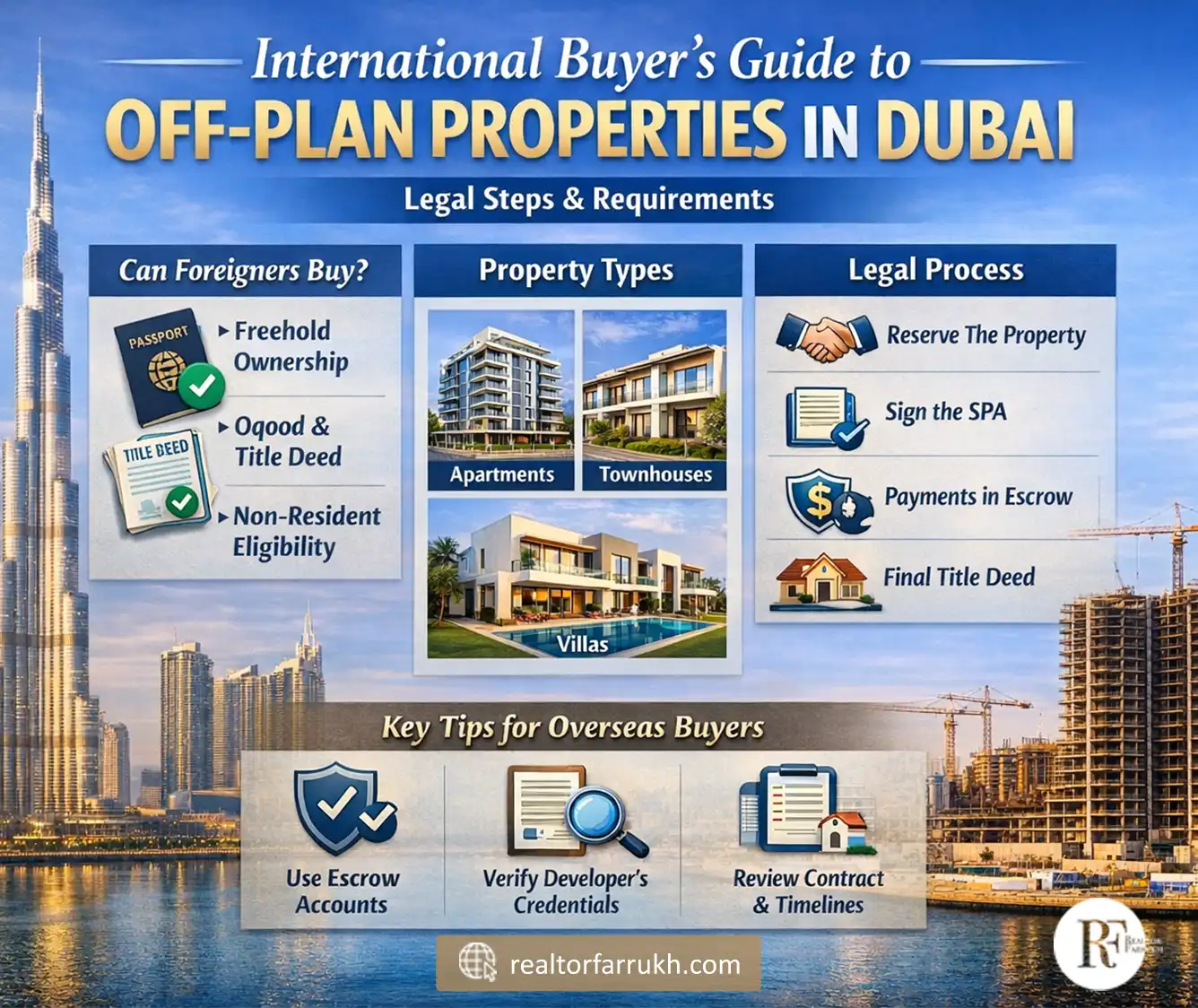
Foreign nationals can buy off-plan property in areas designated for foreign ownership in Dubai, subject to the ownership status of the selected property and applicable registration requirements.
International buyers should verify the project, developer, ownership area, escrow-account information, unit details, payment schedule and Sale and Purchase Agreement before transferring funds.
This guide explains the general buying process. It does not replace independent legal, tax, mortgage or financial advice.
Last reviewed: 4 August 2026
Can Foreigners Buy Off-Plan Property in Dubai?
Yes, non-UAE nationals may acquire certain property rights in areas designated for foreign ownership.
Article 4 of Dubai’s Law No. 7 of 2006 provides that, subject to the applicable approvals, non-UAE nationals may be granted freehold ownership without a time restriction or usufruct or leasehold rights for up to 99 years in designated areas.
This does not mean every property in Dubai has the same ownership status. Before reserving a unit, confirm:
- Whether the development is in an area eligible for foreign ownership
- Whether the property is freehold, usufruct or leasehold
- The name in which the property will be registered
- Whether additional requirements apply to a company purchase
- Whether any restrictions appear in the transaction documents
What Does Buying Off-Plan Mean?
Buying off-plan means purchasing a specified property before construction and handover are complete. The buyer signs contractual documents and pays the purchase price according to the project’s agreed payment schedule.
The purchase should relate to an identifiable unit. Confirm the:
- Project and building name
- Unit number
- Floor level or plot number
- Property type
- Floor plan
- Stated area
- View or orientation, where applicable
- Total purchase price
- Payment schedule
- Contractual completion provisions
Marketing material can help explain the development, but the reservation form and Sale and Purchase Agreement establish the transaction terms.
How Are Off-Plan Purchases Registered?
Dubai Law No. 13 of 2008 regulates the Interim Property Register. It states that transactions involving units sold off-plan must be entered in that register.
Dubai Land Department’s initial-sale registration service allows a developer to register an off-plan unit in the provisional register. The service information lists the Sale and Purchase Agreement and identification documents among the registration requirements.
Buyers should ask the developer to confirm:
- Who will submit the registration
- When it will be submitted
- Which buyer documents are required
- Which registration charges apply
- What evidence of registration will be issued
- How the registration details can be checked
Do not describe an unregistered booking form as proof of registered ownership.
How Does a Project Escrow Account Work?
An escrow account is a bank account established for a specific real estate development project. Purchaser or project-financier payments for off-plan units are deposited into that project account under the applicable framework.
The definition and requirements are set out in Dubai’s Law No. 8 of 2007 concerning real-estate development escrow accounts.
Before making a payment:
- Confirm the registered project name.
- Obtain the payment instructions directly from an authorised source.
- Check that the beneficiary information matches the verified instructions.
- Confirm the project escrow-account details.
- Do not transfer money to an unrelated personal account.
- Keep the bank confirmation and developer receipt.
An escrow account is an important part of the regulatory framework, but it does not remove construction, contractual, market or completion risk.
Step-by-Step Buying Process for International Buyers
1. Define Your Purchase Requirements
Decide whether the property is intended for personal use, future relocation, rental use or another purpose.
Set a budget that covers the purchase price and related costs. Do not base the budget only on the advertised booking amount or first instalment.
2. Choose the Property Type and Location
Compare apartments, villas and townhouses according to your space requirements, budget and intended use.
You can review:
- Off-plan apartments in Dubai
- Off-plan villas in Dubai
- Off-plan townhouses in Dubai
- Dubai off-plan communities
Confirm that the selected development is in an area where the intended ownership type is available to you.
3. Verify the Developer and Project
Check the registered developer, project name and construction information.
Dubai Land Department’s Project Status Enquiry allows buyers to check project details and completion information.
Dubai REST provides additional off-plan information, including completion progress, actual project photographs and escrow-account details.
Do not rely only on a sales presentation, social-media advertisement or third-party price list.
4. Select and Verify the Exact Unit
Request written confirmation of the unit-specific details, including:
- Unit and building number
- Floor or plot position
- Floor plan
- Area
- View and orientation
- Parking allocation
- Total price
- Payment schedule
- Expected completion date
- Included specifications
- Applicable charges
A project’s advertised starting price does not confirm that your preferred unit is available at that amount.
5. Review the Reservation Form
Read the reservation form before paying the booking amount. Confirm whether the payment is refundable and under what circumstances.
Check that the document correctly identifies the buyer, developer, project, unit, price and payment terms.
6. Review the Sale and Purchase Agreement
The Sale and Purchase Agreement should be reviewed as a complete contract. Important provisions can include:
- Purchase price and payment schedule
- Unit specifications
- Completion and handover provisions
- Buyer and developer obligations
- Late-payment consequences
- Cancellation provisions
- Area variations
- Resale or assignment conditions
- Dispute-resolution provisions
- Notices and communication requirements
Consider obtaining advice from an independent legal professional familiar with Dubai property transactions, particularly where the contractual language or ownership structure is unclear.
7. Complete the Required Registration
Confirm with the developer how and when the initial sale will be registered. Provide the required identification documents and retain the registration evidence.
The DLD initial-sale service currently identifies a valid passport as a required document for a non-resident individual. Requirements can differ for residents, companies, representatives and other ownership structures.
8. Make Payments Through Verified Instructions
Follow the payment schedule stated in the signed contract. Before every transfer, verify the beneficiary and payment reference.
International buyers should also allow time for:
- International bank-transfer processing
- Bank compliance checks
- Currency conversion
- Transfer limits
- Public holidays and banking cut-off times
Do not leave a payment until the final day if an international transfer is required.
9. Monitor Construction and Keep Records
Keep copies of:
- Reservation documents
- Sale and Purchase Agreement
- Registration evidence
- Bank-transfer confirmations
- Developer receipts
- Payment notices
- Approved amendments
- Email correspondence
- Construction updates
Use official DLD services to check project information rather than relying only on promotional updates.
10. Prepare for Completion and Handover
Before completion, request the handover procedure and final cost statement.
Depending on the property and contract, the process may include:
- Final payment
- Unit inspection
- Defect reporting
- Utility arrangements
- Completion documentation
- Final registration steps
- Key collection
- Building or community access
- Service-charge arrangements
Use a qualified inspection professional where appropriate.
Documents International Buyers May Need
The exact requirements depend on the buyer, transaction and ownership structure. An individual overseas buyer may be asked for:
- Valid passport copy
- Contact and residential-address details
- Signed reservation documents
- Signed Sale and Purchase Agreement
- Proof of payment
- Compliance or source-of-funds documents
- Additional identification requested by the developer, bank or authority
Company purchases can require incorporation documents, shareholder information, authorised-signatory documents, translations, attestations and other approvals.
Request a transaction-specific checklist before signing or transferring funds.
Costs to Include in Your Budget
International buyers should request a written cost breakdown covering:
- Reservation or booking payment
- Down payment
- Construction-linked instalments
- Amount due at completion
- Applicable DLD registration charges
- Developer administrative charges
- Bank-transfer and currency-conversion costs
- Mortgage expenses, if financing applies
- Independent legal or inspection fees
- Service charges after completion
- Utility, furnishing and fit-out expenses
- Handover or conveyancing-related costs
Fees and payment responsibilities should be verified using the current official schedule and transaction documents.
For completed jointly owned properties, approved information may be available through the DLD Service Charge Index.
Can an International Buyer Use a Mortgage?
Mortgage availability depends on the buyer’s financial position, residency status, lender requirements, developer, project and construction stage.
Before reserving a property based on expected financing:
- Obtain an assessment from a regulated lender or mortgage adviser.
- Confirm whether the selected project is eligible.
- Check the required deposit and documentation.
- Understand when the mortgage funds can be released.
- Maintain an alternative plan if financing is not approved.
A developer payment plan is not the same as a mortgage.
Can You Buy Dubai Property Remotely?
Some transaction stages may be completed while the buyer is outside the UAE, but the exact process depends on the developer, registration requirements, bank procedures and buyer structure.
Confirm:
- Which documents can be signed electronically
- Whether original or notarised documents are required
- Whether a representative or power of attorney is needed
- How identity verification will be completed
- How registration evidence will be delivered
- How international payments must be referenced
Obtain independent advice before granting a power of attorney or signing remotely.
Does Buying Property Automatically Provide UAE Residency?
No. Property ownership and immigration approval are separate matters.
Property investors may qualify for particular residence services if they meet the applicable requirements, but purchasing a property does not itself guarantee that an application will be approved.
Check the current eligibility and documentation directly through the GDRFA Dubai property-owner and investor services or the relevant UAE immigration authority before relying on residency as part of a purchase decision.
Can an Off-Plan Property Be Resold Before Completion?
A resale or assignment may be possible, but it depends on:
- Sale and Purchase Agreement provisions
- Developer requirements
- Amount of the purchase price already paid
- Registration status
- Required no-objection documents
- Administrative and registration charges
- Availability of an eligible buyer
Do not assume that an off-plan property can be resold whenever you choose. Confirm the conditions before signing the original purchase agreement.
Risks International Buyers Should Review
International off-plan buyers should consider:
- Construction and completion delays
- Changes in market prices or rental conditions
- Currency-exchange movements
- Missed international-payment deadlines
- Differences between illustrations and completed specifications
- Planned facilities opening in phases
- Contractual restrictions on resale
- Final service charges not being available at reservation
- Travel or representation requirements
- Consequences of buyer payment default
These risks should be assessed against your budget, intended use and ability to hold the property until completion.
International Buyer Due-Diligence Checklist
Before transferring a reservation payment, confirm:
- The project and developer are correctly identified.
- The property is in an eligible foreign-ownership area.
- The ownership type is stated clearly.
- The exact unit is available.
- The unit-specific price and payment schedule are documented.
- The floor plan and area have been reviewed.
- The project escrow-account information has been verified.
- The reservation refund terms are understood.
- The Sale and Purchase Agreement has been reviewed.
- Registration responsibilities and charges are confirmed.
- Every payment will use verified instructions.
- You can meet the full payment schedule.
- Resale and cancellation conditions are understood.
- Currency and transfer costs are included in the budget.
- Independent advice has been obtained where required.
Get Help Comparing Dubai Off-Plan Properties
Farrukh Hussain, Senior Portfolio Manager at Homes 4 Life Real Estate, can help international buyers compare the off-plan projects currently displayed on Realtor Farrukh.
Share your:
- Purchase budget and currency
- Preferred property type
- Bedroom requirement
- Preferred communities
- Intended use
- Payment capacity
- Required completion timeline
- Mortgage requirement
- Country of residence
You will receive a shortlist based on these requirements, followed by the latest available documents for the projects you choose to review.
Availability, prices, payment plans and commercial terms must be reconfirmed before reservation.
Frequently Asked Questions
Can foreigners legally buy off-plan property in Dubai?
Foreign nationals may acquire specified property rights in areas designated for foreign ownership, subject to applicable Dubai rules. Confirm the location and ownership type of the selected property before reservation.
Do I need to live in the UAE to buy an off-plan property?
A buyer does not necessarily need to be a UAE resident, but identification, registration, banking and developer requirements still apply. Request a transaction-specific document checklist.
What is the Interim Property Register?
It is the register in which off-plan sale contracts and related transactions are recorded before their inclusion in the final Property Register, as regulated by Dubai Law No. 13 of 2008.
What is Oqood?
Oqood is associated with Dubai’s provisional off-plan registration process. Buyers should ask the developer for evidence that the particular sale has been submitted and registered correctly.
Should I pay the developer or the project escrow account?
Follow only verified payment instructions issued for the particular transaction. Confirm the project escrow-account information and do not transfer funds to an unrelated personal account.
Is an off-plan payment plan interest-free?
Do not assume this from the instalment structure alone. Review the total price and contract to identify all charges, late-payment provisions and financing-related costs.
Can buying property provide a UAE residence visa?
Property investors may be eligible for particular residence programmes if they meet the current requirements. Ownership does not automatically guarantee approval, and immigration eligibility should be verified separately.
What should I check before paying a booking amount?
Verify the project, developer, ownership status, exact unit, price, payment plan, escrow details and reservation refund terms. Read the reservation document before transferring the payment.
Are returns from an off-plan property guaranteed?
No. Future prices, rents, occupancy, operating costs and completion timelines can change. Any investment assessment should use evidence-based assumptions and consider both positive and negative scenarios.