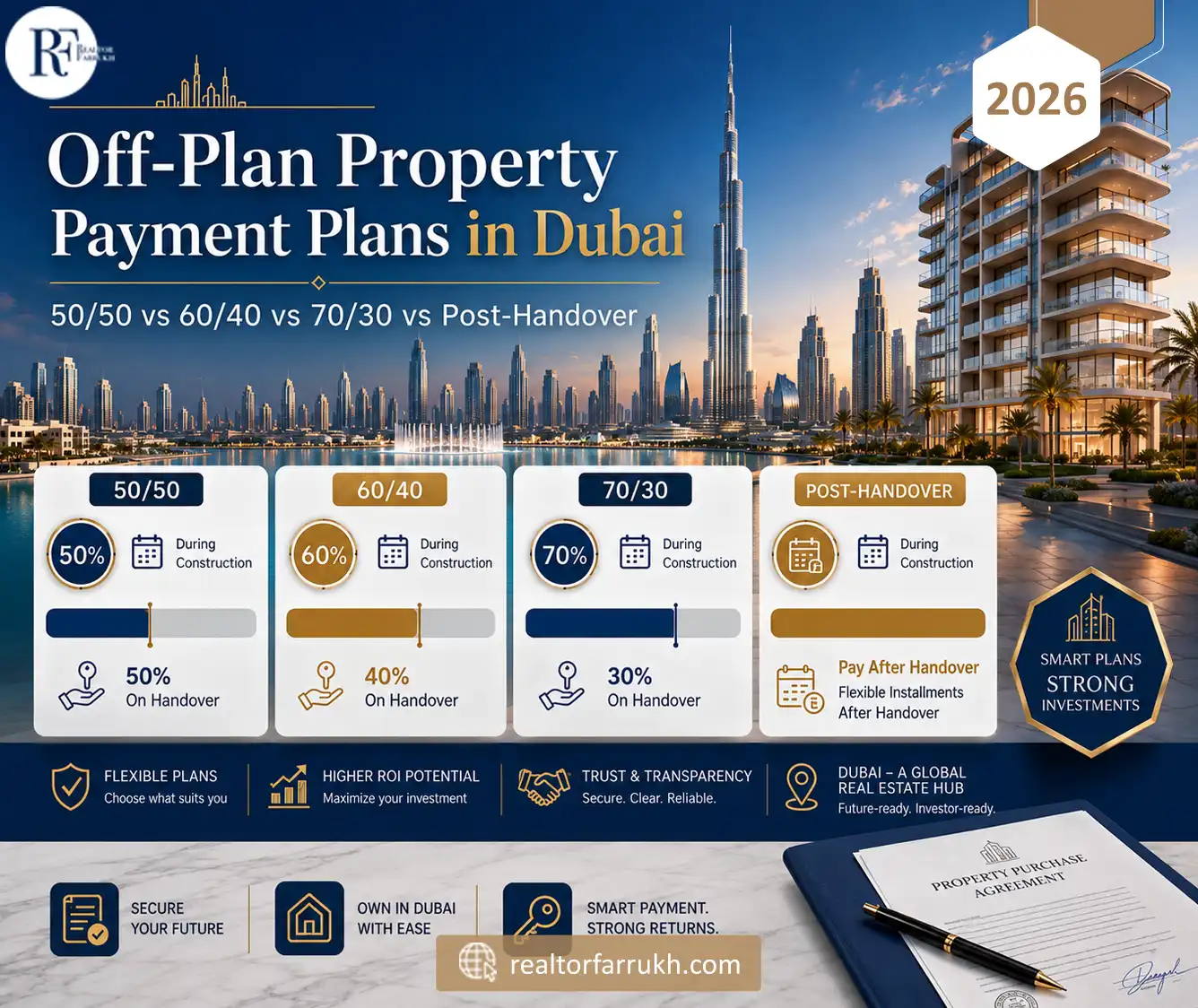
Why Payment Plan Matters in Dubai Off-Plan Property
When buyers search for off-plan payment plans in Dubai, they are usually not asking only about percentages. They are really asking four deeper questions at once: how much cash is needed before handover, how large the final payment cliff is, how exposed they are if a project is delayed, and whether the plan fits their purpose as an investor or end user. In Dubai, the developer-issued SPA governs the construction timeline, stage-based payment schedule, handover conditions, and warranty or defect-liability periods, so the payment plan is not just a marketing label. It is part of the legal and financial structure of the purchase.
From a safety standpoint, the percentage split is only one part of the picture. Dubai’s framework requires off-plan disposals to be registered on the Interim Real Estate Register, and the DLD guide says unregistered disposals can be treated as null and void. The same DLD materials also state that developers must obtain approvals before launching or selling off-plan units, and every off-plan project must have its own escrow account. DLD’s Project Status Enquiry and Dubai REST services let buyers check completion percentages, project details, escrow account information, and amounts due.
That is why a “safer” payment plan is not automatically the plan with the lowest upfront percentage. A plan is safer when the project is properly registered, the escrow setup is in place, the milestones are realistic, and your own cash flow can meet the schedule without strain. Oqood records your off-plan rights during construction, while the title deed is issued after completion and final registration, so buyers should think about payment timing and documentation together.
Before comparing payment plans, buyers should first understand the type of property they are buying and whether it fits their purpose. You can explore available off-plan properties in Dubai to compare different projects, prices, handover timelines, and developer payment structures in one place.
What Is a Fifty-Fifty Payment Plan?
In Dubai property language, a 50/50 payment plan Dubai usually means that half of the property price is paid during construction and the remaining half is paid at completion or handover. Meraas describes a fifty-fifty plan exactly this way, and Binghatti uses the same split when explaining standard off-plan structures.
For cash flow, a fifty-fifty structure is usually easier than heavier pre-handover plans because it leaves a larger share of the price unpaid until the asset is closer to delivery. That can suit buyers who want to preserve liquidity during construction, buyers expecting a bonus or business proceeds later, or buyers planning to arrange financing closer to completion. The trade-off is obvious: the final payment is large, so if your handover funding plan is weak, a fifty-fifty plan can feel comfortable early and stressful later. This is an inference from the structure set out in the cited developer guidance.
For end users, this plan can work well when they want a softer construction period and expect to be financially stronger by handover. For investors, it can also work when the strategy is to hold until completion or refinance near delivery. But it is not automatically “better” than other plans, because the large handover exposure still has to be solved in cash, mortgage proceeds, or a permitted exit.
A 50/50 payment plan is commonly considered by buyers looking for manageable construction-stage payments, especially when comparing smaller units such as off-plan apartments in Dubai where the overall ticket size may be more affordable than villas or larger family homes.
What Is a Sixty-Forty Payment Plan?
A 60/40 payment plan Dubai usually means that sixty percent is paid before handover and forty percent is left for the final stage. In standard versions, that last forty percent is due at completion or handover; however, some developers also market sixty-forty structures where the final forty percent is paid after handover over time. This is one of the most important points buyers miss: the headline ratio alone does not tell you whether the final balance is a single cheque at key handover or a post-handover instalment stream. You must read the SPA schedule.
In budget terms, a sixty-forty plan sits in the middle. It asks for more commitment during construction than a fifty-fifty structure, but it leaves a smaller end-stage cliff than a plain seventy-thirty plan with a strong construction burden. That makes it a common “middle-ground” Dubai property payment plan for buyers who have decent income now but still want meaningful deferral toward the end. Again, this suitability point is an inference from the documented payment structures.
This is also the category where incentives can complicate comparisons. DAMAC has advertised sixty-forty offers together with a four percent DLD waiver, while some individual project sales pages describe immediate deposits and milestone instalments before a final balance. So buyers should compare the net cost, not just the split. A sixty-forty plan with a strong waiver or better base pricing may be more attractive than a softer-looking competitor on a higher total purchase price.
What Is a Seventy-Thirty Payment Plan?
A 70/30 payment plan Dubai generally means that seventy percent of the purchase price is paid before handover and thirty percent is left to the final stage. Emaar has marketed a seventy-thirty structure together with a two-year post-completion payment plan, which shows that even this ratio can appear in more than one practical form: the final thirty percent may be due at handover in some projects, or spread post-completion in others.
From a budgeting perspective, a seventy-thirty plan is heavier during construction because more of the price is committed earlier. That usually makes it less comfortable for buyers whose main concern is preserving liquidity before handover. On the other hand, it can appeal to buyers with stronger current cash flow who want less of the price left at the end, especially if the final thirty percent is stretched post-completion rather than collected all at once. This is an inference based on the documented structure.
For investors, seventy-thirty can make sense when the goal is to secure a project in a good location and the buyer is comfortable tying up more capital during the build phase. But the more capital you commit before completion, the more important developer quality, construction progress, resale rules, and market timing become. Emaar’s own off-plan guidance highlights flexible plans, competitive pricing, potential returns, and the role of the DLD and RERA framework in protecting investors.
What Is a Post-Handover Payment Plan?
A post handover payment plan Dubai allows the buyer to continue paying part of the property price after receiving the keys. Binghatti describes these structures as extending payments beyond possession, typically for about two to five years, with an initial down payment, instalments during construction, a handover amount, and then monthly or quarterly payments after handover. The same guide notes that many such plans require about forty to sixty percent during construction, with the remainder spread after possession.
This is usually the easiest structure for monthly cash flow because peak funding pressure is reduced. It can lower the entry barrier for first-time buyers and smaller investors, and it may be appealing to investors who expect rental income after completion to support ongoing instalments. But the key caveat is timing: you cannot rent an off-plan property before it is completed, so there is no rental income during construction, and once handover happens the owner also becomes responsible for service charges and other ownership costs.
That makes post-handover attractive, but not automatically better. It often gives the softest short-term cash flow, while also extending your obligations into the ownership period. If your income is stable and you want maximum breathing room, post-handover can be very practical. If you dislike long financial tails and want the property substantially paid off by move-in, a standard fifty-fifty or sixty-forty plan may feel cleaner.
Which Payment Plan Is Better for Your Budget?
The best answer depends on how your income arrives, how soon the project hands over, whether you plan to live in the property or invest, and whether you are comfortable with a large final balance. Buyers who are strongest on current liquidity may tolerate a heavier construction schedule. Buyers who care most about avoiding a large early cash outlay often lean toward fifty-fifty or post-handover structures. Buyers who want a middle path often end up comparing sixty-forty offers very closely, paying particular attention to whether the final forty percent is at handover or after it.
For investors, the practical question is usually whether the plan supports the intended exit. If the strategy is capital appreciation and possible resale before or around handover, lower pre-handover funding can preserve flexibility, but only where the SPA and developer allow resale and the related fees are understood. Emaar’s online terms explicitly say the SPA may restrict resale before handover without vendor approval, and Binghatti separately warns buyers to understand developer transfer rules and fees.
For end users, the practical question is usually which plan best protects household cash flow. If the buyer wants to move in with most obligations already cleared, a standard fifty-fifty or sixty-forty can be easier to live with psychologically, provided the handover payment is fully planned. If the buyer wants the lowest near-term strain, post-handover is often the gentlest option, but it means living with continuing instalments after possession.
End users buying for family living should not judge the payment plan only by the lowest upfront amount. For larger homes such as off-plan villas in Dubai, the total price, handover payment, service charges, and long-term affordability become more important than the headline payment split.
Buyers who want more space but do not want the full price level of a villa can also compare off-plan townhouses in Dubai, where payment plans may still be flexible but the final budget can be easier to manage than large standalone villas.
Payment Plan Comparison Table
The “cash-flow profile” and “buyer fit” column below are practical inferences drawn from the documented structures and obligations in the cited sources.
| Plan | Typical meaning in Dubai | Cash-flow profile | Buyer fit | Main caution |
|---|---|---|---|---|
| Fifty-fifty | Fifty percent during construction and fifty percent at completion or handover | Softer before handover, but a large final payment cliff | Buyers preserving liquidity during construction; end users expecting stronger finances by handover | Final balance can still be very large |
| Sixty-forty | Usually sixty percent before handover and forty percent at handover, though some projects stretch the forty percent post-handover | Middle-ground structure | Buyers wanting balance between current affordability and end-stage deferral | Ratio alone can be misleading unless the SPA shows exact timing |
| Seventy-thirty | Seventy percent before handover and thirty percent at the final stage; some offers pair it with post-completion terms | Heavier construction-period burden | Liquidity-strong buyers comfortable committing more capital earlier | More capital tied up before completion |
| Post-handover | Part paid during construction, with the remaining balance paid after receiving the keys over time | Usually easiest on short-term cash flow | First-time buyers, cash-flow-sensitive end users, investors planning long holds | Ownership costs continue while developer instalments may still be running |
Buyer Checklist Before Choosing a Payment Plan
Before signing, the buyer should check five things in writing, not by sales conversation alone.
- Confirm that the project is properly registered, the developer has the required approvals, and the project’s escrow structure exists. Off-plan registration and escrow are part of Dubai’s core investor-protection framework.
- Check the project’s real completion status through DLD Project Status Enquiry or Dubai REST, not just the brochure timeline. These tools show completion percentages and project details, and Dubai REST can also show actual project pictures and the escrow account number.
- Read the SPA section on due dates, handover conditions, grace periods, late-payment consequences, and delay remedies. The SPA governs stage-based schedules, handover conditions, warranties, and defect-liability periods, and some vendor terms also allow strong remedies if the purchaser defaults.
- Check whether resale before handover is allowed, and what transfer fees or approvals apply. This matters much more for investors than most first-time buyers realize.
- Model the full acquisition cost, not just the instalments: DLD or Oqood charges, title-deed and map fees, mortgage fees if financed, trustee fees where applicable, and service charges after handover.
The developer behind the project matters as much as the payment plan itself. Before choosing any 50/50, 60/40, 70/30, or post-handover offer, compare the track record of Dubai off-plan developers, including delivery history, project quality, escrow registration, and buyer support after handover.
Costs Not Always Included in the Payment Plan
The first hidden line to verify is registration. DLD’s initial-sale service shows a two percent seller fee and a two percent purchaser fee, while Meraas states the standard DLD fee is four percent of the property value. In practice, off-plan buyers should budget for roughly that four percent registration cost unless the developer is explicitly waiving it. Promotional waivers do exist, but they are not uniform: some offers advertise a full four percent DLD waiver, while others only waive half.
The second cost bucket appears around completion and final registration. DLD’s completion-of-initial-procedures page lists title deed fees for apartments or villas, map fees, and small knowledge and innovation fees. In other words, even when the registration fee has already been collected, the handover stage can still entail paperwork costs that buyers overlook when they focus only on the instalment ratio.
If the purchase is financed, mortgage registration is an additional cost line item. DLD states that mortgage registration carries a charge of zero-point-two-five percent of the mortgage value, and developer guidance also reminds buyers to budget for trustee fees and service charges beyond the purchase price.
Service charges are easy to underestimate because they often appear only when buyers start thinking like owners rather than purchasers. DLD’s Service Charge Index exists precisely so buyers can check approved charges for jointly owned properties, and DLD has also stated that the owner is liable for service and usage charges for common areas unless the lease provides otherwise. That means a post-handover plan can overlap with service-charge obligations after keys are received.
Tax treatment is another area that confuses buyers. The Federal Tax Authority states that residential properties are generally exempt from VAT, while the first supply of a residential property within three years of completion is zero-rated. The practical takeaway is that buyers should not assume tax works like a standard five-percent retail surcharge on ordinary residential purchases; if the asset is not straightforward residential inventory, the exact tax treatment should be checked carefully.
Finally, watch for SPA language that moves extra costs back onto the purchaser. Emaar’s terms say the buyer may be required to pay pre-registration and final-registration charges, related land-department amounts, and any changed charges over time. The same terms also note that resale before handover may require prior vendor approval. So hidden cost review should always include both the fee sheet and the contract language.
FAQs
Is post-handover better?
It is often better for monthly cash flow because it pushes part of the balance into the ownership period, but it also means you may still be paying the developer after you receive the keys, while service charges and other ownership costs start to matter. So it is better for some budgets, not for every buyer.
Which payment plan is easiest?
For many buyers, post-handover is the easiest on near-term cash flow, while fifty-fifty is often the easiest among standard non-post-handover structures because it leaves more unpaid until completion than sixty-forty or seventy-thirty. But “easiest” changes if you already know you can handle a large handover payment without stress.
Which payment plan is safest?
No ratio is safest on its own. Safety comes from the regulatory and contractual basics: valid off-plan registration, escrow protection, verified project status, realistic milestones, and SPA clauses you can actually comply with. A badly understood soft plan can be riskier than a stricter plan on a well-vetted project.
What hidden costs should be checked first?
Start with registration fees, then title-deed and map issuance fees, mortgage registration if financing is involved, trustee-related charges where applicable, service charges after handover, and any SPA clauses on transfer restrictions or changed registration costs.
Final Advice
The strongest version of this article should make one point very clear: there is no single best answer for all buyers comparing off plan payment plans Dubai. A fifty-fifty plan usually reduces pre-handover strain but leaves a larger final cliff. A standard sixty-forty plan is often the middle-ground option, but buyers must verify whether the final forty percent is due at handover or after it. A seventy-thirty plan usually requires stronger current liquidity. A post-handover plan is often the most forgiving for immediate cash flow, but it extends your obligations into the ownership period. The right choice depends on your income timing, handover expectations, total price, and whether you are buying for capital growth, rental strategy, or personal use. The safest route is to match the plan to your real cash flow, verify the project through DLD tools, and read the SPA as closely as you read the brochure.