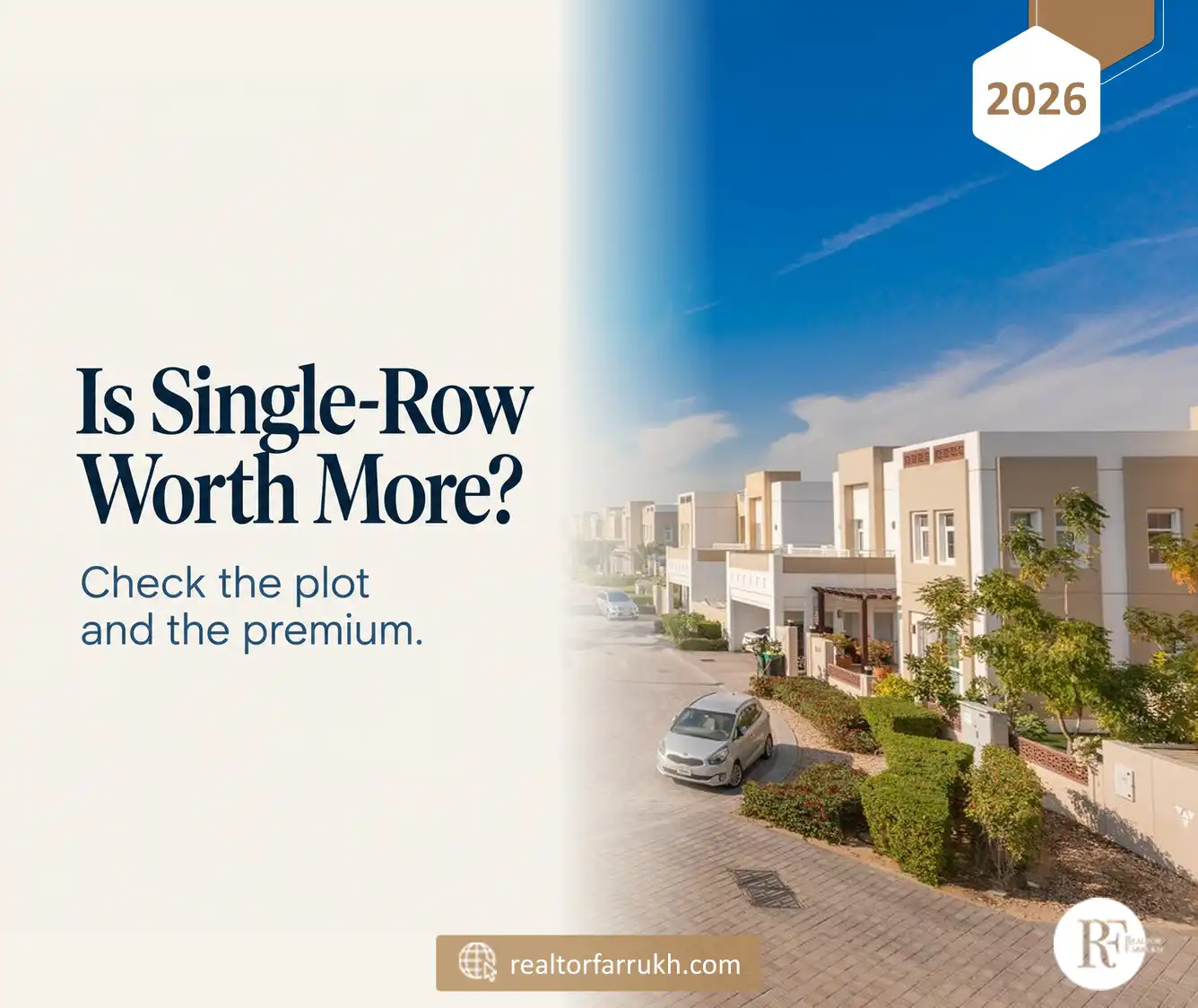
Check the plot before paying the premium
Two townhouses can have the same bedrooms, floor plan, and finishes, yet carry different prices because of their position. The question is whether the more expensive home gives you privacy, an outlook or practical space you will actually use.
Quick answer: A single-row townhouse usually has no immediate residential row behind its rear boundary. Back-to-back homes generally back onto another home’s garden. Pay extra only when the verified position, privacy and ownership costs justify it.
What do single-row and back-to-back mean?
These are common property-marketing descriptions. Confirm the arrangement on the exact plot plan because layouts and terminology vary between projects.
| Description | What it usually describes | What to check |
|---|---|---|
| Single-row | No immediate residential row directly behind the home | What occupies the land behind the rear boundary |
| Back-to-back | Another residential row behind, often garden to garden | Separation, window positions and garden privacy |
| Middle unit | A home between neighbouring homes within a terrace | Shared side walls, windows and side access |
| End or corner unit | A position at the end of a terrace or on a corner plot | Actual boundaries, road exposure and usable outdoor area |
Rear positioning and side attachment are separate checks. A middle townhouse can be single-row. An end townhouse can still have another home behind its garden. A corner label does not establish a quiet outlook.
If you are still choosing between property types, start with the villa versus townhouse comparison.
Read the floor plan and plot plan together
The floor plan shows the home: rooms, doors, stairs and dimensions. The plot plan places that home within its surroundings. You need both.
For example, the layouts listed for DAMAC Islands 2 Townhouses include middle and end-unit descriptions. Those labels do not establish what sits behind a selected home. Request the unit reference marked on the current developer plan.
Dubai Land Department’s Property Map Request service covers maps for registered properties, including land, units and villas. For an off-plan purchase, obtain the relevant developer plot documents and clarify which official mapping is available at that stage.
Check the plan date and legend. Identify your boundary, the neighbouring plots and any intervening path or landscaped strip. Communal greenery outside your boundary should not be counted as your private garden.
Check what is behind the townhouse
A single-row label leaves several questions unanswered.
Park or landscaped corridor: Check the distance to paths, play areas, seating and sports facilities. An open outlook may suit you, while activity close to the garden may not. Confirm whether any advertised rear gate or park access is included.
Road or service access: Establish whether the road is internal, a delivery route or a wider traffic corridor. Review its relationship to the garden and bedrooms. For an accessible completed home, visit at different times.
Undeveloped land: Ask what the adjoining parcel is designated for on the current plan. Request clarification of known future phases. An attractive render does not establish a permanently protected view.
Another residential row: Review the distance between homes and the position of upper-floor windows. A back-to-back arrangement with useful separation may meet your needs.
Orientation and screening: Check the north arrow, glazing, shade and boundary treatment. A larger garden has less practical value if its shape or exposure makes it uncomfortable for your intended use.
When comparing off-plan townhouses in Dubai, request prices alongside unit references and plot positions. Otherwise, you may compare a standard home in one project with a premium plot in another.
How much extra is the position worth?
There is no universal percentage to pay for single-row positioning. Start with homes in the same phase, with similar layouts, plots, payment timing and handover expectations.
Then ask what explains the difference. It might include plot size, an end position, an incentive or a different payment plan as well as rear outlook.
An illustrative purchase and rental comparison
The figures below are hypothetical. They are not current quotations, rental forecasts or a valuation of any named project.
Both examples assume a cash purchase, the buyer funding the full 4% registration fee, and an illustrative AED 10,000 allowance for other buying costs. Replace that allowance with itemised charges. DLD’s off-plan registration-fee notice describes a 4% fee and payment according to the seller-buyer agreement; confirm your transaction’s terms.
| Model input or result | Back-to-back | Single-row |
|---|---|---|
| Purchase price | AED 3,000,000 | AED 3,150,000 |
| Assumed buyer-funded DLD fee | AED 120,000 | AED 126,000 |
| Other buying costs: illustrative allowance | AED 10,000 | AED 10,000 |
| Modelled acquisition cost | AED 3,130,000 | AED 3,286,000 |
| Assumed annual rent before vacancy | AED 180,000 | AED 185,000 |
| Assumed annual costs and vacancy allowance | AED 25,000 | AED 25,000 |
| Modelled annual net operating income | AED 155,000 | AED 160,000 |
| Net operating yield on acquisition cost | 4.95% | 4.87% |
The single-row home produces AED 5,000 more annual net income in this example, but requires AED 156,000 more capital. Its percentage yield is slightly lower.
To match the back-to-back home’s modelled yield, it would need approximately AED 162,725 net income, or AED 187,725 gross annual rent with the same AED 25,000 costs and allowance.
Net operating yield = annual rent after operating costs and vacancy allowance ÷ total acquisition cost × 100.
Financing, personal taxes, selling costs and capital growth are outside this annual operating-yield calculation. The equal annual allowances are a modelling assumption, not evidence that both homes cost the same to run.
Where relevant approved charges are available, use DLD’s Service Charge Index. An estimate for an unfinished development should remain labelled as an estimate.
Payment timing matters too. With an assumed 20% booking instalment on both homes, the AED 150,000 price difference initially adds AED 30,000 to the booking payment. The remaining premium and additional fees still need funding later.
Which arrangement fits your purchase?
| Buyer priority | When single-row may fit | When back-to-back may fit |
|---|---|---|
| Family occupation | The verified privacy and outlook improve daily use enough to justify the price | Separation and screening already provide sufficient comfort |
| Rental income | Credible comparable rents support the additional acquisition cost | The lower entry cost leaves a stronger net yield |
| Budget flexibility | The premium leaves room for later instalments, landscaping and reserves | Keeping more cash available matters more than the outlook |
Single-row is less suitable when the rear position is poorly documented or the premium stretches your payment capacity. Back-to-back is less suitable when overlooking would prevent you from enjoying the garden or bedrooms.
For resale, compare the likely future buyer’s alternatives. A useful position may help distinguish the home, but it does not guarantee a faster sale or recovery of the original premium.
Before booking, request these six items
-
The exact unit reference and dated plans. Match the quotation, floor plan, plot plan and reservation documents.
-
Rear-parcel information. Identify neighbouring homes, roads, facilities, undeveloped parcels and known later phases.
-
Separate plot and built-up areas. Check garden dimensions, parking, setbacks and any access or service restrictions.
-
An itemised acquisition-cost statement. Include registration, administration and any applicable agency or finance costs, with incentives in writing.
-
The full payment schedule and SPA. Review completion, permitted changes and resale conditions. Obtain legal review where contractual rights need interpretation.
-
Relevant rental and sale comparisons. Prefer closely matched homes. Advertised asking prices and rents are not completed transactions.
If a claimed advantage cannot be located on the plan or explained in the documents, leave it out of your valuation until it is verified.
Make the choice around the actual plot
For a family home, decide how much the verified privacy and outlook are worth to your household. For an investment, test the extra capital against supportable net income and the alternatives available to future buyers.
Compare the same details across your shortlist of off-plan properties in Dubai: the home, plot, backing, full price and payment dates.
Want help comparing two townhouses? Send me the unit references, plot plans, quotations and payment schedules through WhatsApp. Include whether you plan to live in the home or rent it out.
Frequently asked questions
Does single-row mean the townhouse has only one shared wall?
No. Single-row usually describes rear positioning. The number of shared side walls depends on whether the home is a middle, end or other configuration. Check both the floor plan and plot plan.
Is a single-row townhouse always quieter?
No. Its rear boundary could face a road, service access or an active communal space. Check the surroundings and the location of bedrooms and outdoor seating.
Does single-row guarantee a larger plot?
No. Compare the documented plot areas and usable garden dimensions. A difference in rear positioning does not establish a difference in land area.
Is back-to-back a poor investment?
No. A correctly priced home with a practical layout and sufficient privacy may suit tenants and produce a better percentage yield. Assess comparable rents and full ownership costs.
What percentage premium should I pay for single-row?
There is no reliable universal percentage for every Dubai community. Compare similar homes within the same phase and separate the effects of plot size, layout, payment terms and rear outlook.
Can an empty plot behind the home be treated as a permanent view?
No. Obtain the current plan and clarify the adjoining parcel’s designated use. Have any claimed contractual view or access protection independently reviewed before relying on it.