By Syed Farrukh Hussain · Dubai off-plan property advisor · BRN 53969
Sources checked 25 November 2026
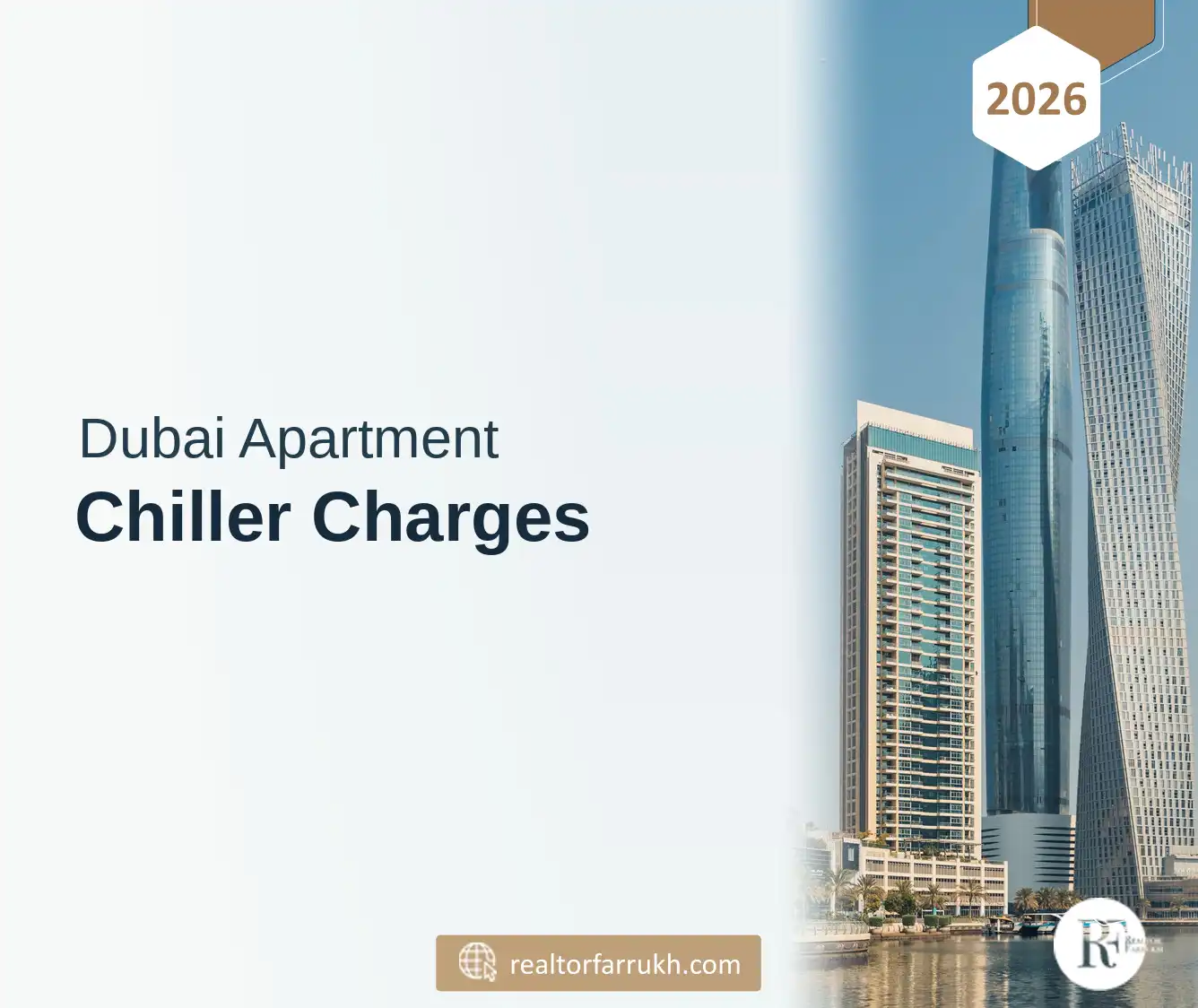
Before buying a Dubai apartment, get written confirmation of who pays for cooling inside the unit, which charges continue when it is empty, and what you will pay to open the account at handover. Then add your annual share to the building’s service charge. That gives you a fairer comparison when one apartment is advertised as chiller-free and another has an itemised cooling bill.
The same apartment can have district cooling and be offered on a chiller-free lease. District cooling describes how cooling reaches the building. Chiller-free describes a billing arrangement. As the buyer, you need to trace who ultimately bears the cost. When you compare off-plan apartments in Dubai, add cooling to the shortlist before you put down a reservation deposit. Dubai cooling regulator overview
Find out where the cooling cost appears
In a district cooling network, a central plant supplies chilled water to buildings. A unit account may show a capacity charge for the cooling capacity made available to the apartment and a consumption charge based on recorded usage. Billing, metering and any other applicable charges depend on the authorised tariff and agreement for the building. Ask for the capacity allocated to the exact unit. TR measures cooling capacity and TRh measures cooling used over time. Ask for the allocation even when two units have the same bedroom count. RSB tariff rules, RD10
The first question for a chiller-free offer is, “Free to whom, and for how long?” A tenant may have cooling covered under a lease while the landlord pays the bill. A developer may cover specified items for a limited period. If a seller says cooling is absorbed through the building’s service charges, ask the building manager to show where the approved budget accounts for it and which parts of your unit’s cooling are covered. There may also be a separate charge under the cooling agreement. Get the start date, expiry date, caps, and any conditions that apply after resale or letting in writing.
Some buildings use electricity-powered AC equipment served through the apartment’s electricity meter. In that setup, budget the cooling-related electricity in the DEWA estimate. A building with a central plant can have its own billing arrangement too. RD10 allows approved consumption billing for units served by a system classified as a Single Building District Cooling System and bars capacity charges to those units. Ask the billing agent to confirm the system classification in writing when a brochure lists “central AC”. RSB tariff rules, RD10 · DEWA electricity tariff
Think through how you will use the unit before choosing a usage assumption. A family living there all summer, an owner visiting for several weeks, and someone who works from home can put very different demands on the system. Ask for a sample from a similar unit in the same building with a comparable occupancy pattern. For an off-plan apartment, a completed building can help you set a range if it has a similar unit type and billing structure. Keep the estimate provisional until your building’s own terms are confirmed.
Check the service charge and the unit bill side by side
Request the project’s service-charge breakdown and the apartment’s cooling breakdown. Cooling for corridors and other shared spaces is a building cost. Under RD06, the provider bills common-area cooling to its customer, and billing agents must keep those costs out of unit occupants’ separate cooling bills. Ask the building manager how shared costs are reflected in the approved project budget. Under Dubai Law No. 6 of 2019, a management entity needs RERA approval to collect applicable service charges from owners.
For a completed building, check the project, usage and budget year in the Dubai Land Department’s Service Charge Index. Ask for 12 months of cooling statements for the apartment, with personal details removed, so the sample spans both hot and cooler months. Record whether the apartment was occupied over that period. A low bill for an empty unit gives you little evidence about usage once you move in. For off-plan, a written service-charge estimate can help with budgeting while approval is pending. The Dubai off-plan service-charge guide explains what to request. DLD Service Charge Index
Compare two apartments using the annual cost
Suppose you plan to live in the apartment. You are choosing between two comparable units, with Apartment B costing AED 35,000 more to buy. In this worked example, Apartment A has a separate unit cooling bill. Apartment B’s written terms cover unit cooling through the annual amount shown, with zero additional metered unit charges in the example. The rates, capacity and usage are hypothetical inputs. The table models the cash amounts for these cost lines over one year.
| Cost line | Apartment A | Apartment B |
|---|---|---|
| Purchase price | AED 1,600,000 | AED 1,635,000 |
| Building service charge for the year | AED 12,000 | AED 15,900 including unit cooling |
| Separately billed capacity for the year | 2.5 TR × AED 720 = AED 1,800 | AED 0 |
| Separately billed metering for the year | AED 10 × 12 = AED 120 | AED 0 |
| Separately billed usage for the year | 5,000 TRh × AED 0.60 = AED 3,000 | AED 0 |
| Annual total for these cost lines | AED 16,920 | AED 15,900 |
Apartment B saves AED 1,020 a year at the assumed usage. Over five years that is AED 5,100 if tariffs, usage and the cooling arrangement stay the same. If the cooling arrangement is your only reason to pay the AED 35,000 premium, this example recovers just AED 5,100 of it through the modeled bills over your five-year hold. The comparison leaves out financing, resale value and changes in charges. Layout, location and other advantages may still justify paying more.
Your usage can flip the result. Apartment A’s annual base across the listed items is AED 13,920 before usage. Its costs match Apartment B’s at 3,300 TRh in the year. That is the AED 1,980 difference between Apartment B’s annual bill and Apartment A’s base, divided by the assumed AED 0.60 per TRh. At 2,500 TRh, A would cost AED 15,420 and have lower bills in this model. At 6,500 TRh, A would cost AED 17,820 and B would have lower bills. Recalculate using the unit’s tariff, including any applicable surcharge or tax, and check the effect if an offer expires after the first year.
Allow for handover cash and time between tenants
At handover, ask for a schedule that separates recurring charges, one-time activation costs and refundable deposits. If your quote shows AED 200 for activation and AED 1,200 for a refundable deposit, budget AED 1,400 in opening cash. Treat the AED 200 as an expense and the AED 1,200 as cash tied up until you satisfy the refund conditions. Ask when the capacity charge starts and when your account can be transferred or closed. Emicool’s customer FAQ illustrates how activation charges and deposits sit alongside recurring bills. Emicool customer FAQ
For a rental investment, write down what the tenant pays during the lease and what you pay between tenants. Check that the provider can register the correct account holder and that the proposed tenancy terms match. A vacant apartment can still incur fixed capacity or billing charges under the applicable terms. Using the worked example, two empty months on Apartment A’s account would cost the owner AED 320 in capacity and metering alone if both charges continue, plus any usage. Include those months in your cash flow. Emicool customer FAQ
If you offer a chiller-free lease and cover the whole bill, deduct the owner-paid cooling amount from expected rent when you calculate net income. Ask whether comparable tenants actually pay more for that lease structure. Check completed lettings or written rental evidence for similar units, and compare rents with the same cooling terms. A higher asking rent can overstate what the owner keeps. If you use the Dubai off-plan project directory to widen your shortlist, carry the same cooling assumptions through each comparison until you have unit-specific figures.
Send this request before reserving
Please confirm the cooling system and billing provider for this unit. Send the allocated capacity, if applicable, the approved tariff or written estimate, a sample bill, and all setup fees and deposits. Show which costs sit in the building’s service charges, which are billed to the apartment, who pays before occupancy and during vacancy, and when any included-cooling offer ends. Please identify the document that records each commitment.
If the development is still under construction, ask who will confirm the pending details and when you can expect them. A good floor plan can still fit your budget when you allow for a range of cooling costs. If the purchase only makes sense at the lowest estimate, wait for the written terms before reserving. If you are buying a ready apartment, also ask for confirmation of the outgoing cooling account’s settlement and the steps for setting up yours.
Request an apartment running cost comparison
Message Farrukh on WhatsApp with your budget, preferred areas, bedroom count, planned use, what you can pay at booking, and your target handover or move-in date. Send the unit numbers or cost sheets if you have them. I can compare the documented cooling and service-charge costs on your shortlist and flag the figures you still need to confirm before reserving.