By Syed Farrukh Hussain | Licensed Dubai real estate advisor, BRN 53969 | Senior Portfolio Manager, Homes 4 Life Real Estate
Sources checked: 26 November 2026.
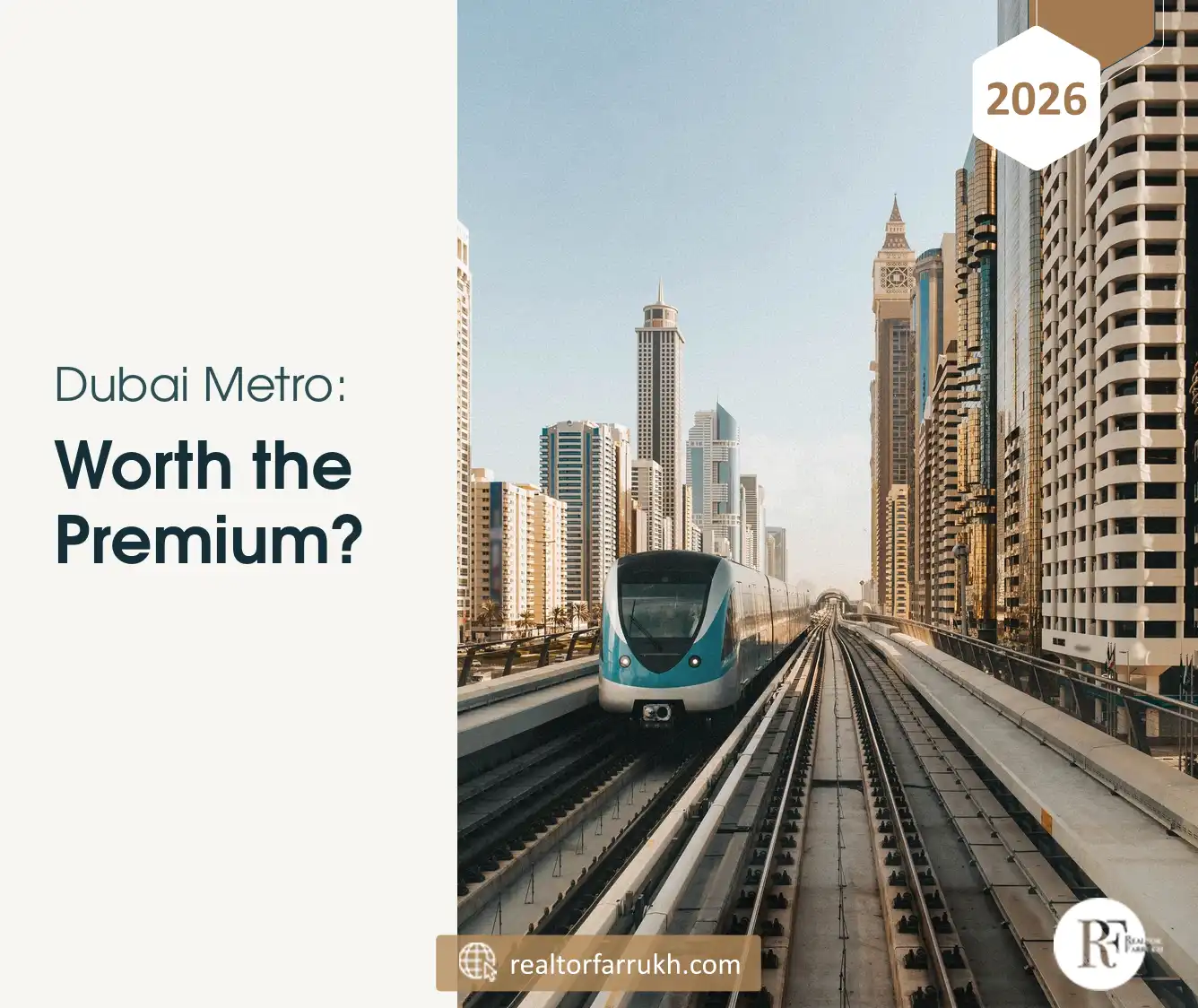
Buying an apartment near Dubai Metro can be worthwhile if the station gives residents a useful daily connection and the extra purchase price is supported by the property's quality, realistic rental income or savings in travelling time. However, paying more simply because a developer describes an apartment as “close to the Metro” is not a sound buying decision.
The important question is not whether the building is near a station on a map. It is whether you or your future tenant can reach the right station conveniently, and whether the benefits justify the premium over a comparable apartment farther away.
For off-plan buyers, the distinction is especially important because a building and its nearest future station may be completed at different times.
What Does Buying Near Dubai Metro Actually Give You?
A well-connected apartment can attract people who travel regularly to offices, universities or other destinations served by public transport. It may also appeal to households that want to reduce their dependence on a car.
There is historical evidence for the benefits of connectivity. CBRE's Dubai Metro Report 2023 examined approximately 74,000 sales and 112,000 rental contracts. From the beginning of 2010 to the end of 2022, residential properties no more than a 15-minute walk from Red Line stations recorded average price growth of 26.7%, compared with 24.1% across Dubai during the same period.
However, the properties in the 5–10-minute group recorded price growth of only 0.2% over that period. Performance differed substantially by location and distance. The study did not establish that every apartment near a station was sold at a premium or would appreciate faster in the future. Those historical figures are not a current market valuation or a forecast.
When comparing off-plan properties across Dubai, treat Metro access as a property feature to verify, not a substitute for checking the developer, layout, purchase price and payment schedule.
How Close Is Close Enough to a Metro Station?
Measure the journey from the building's normal pedestrian entrance to the station entrance you will actually use. A straight-line distance on a sales map does not account for roads, crossings, fences, bridges or walking around another development.
Use the official RTA Journey Planner to examine the available public transport connection to your usual destination. Where possible, walk the route yourself. For an unfinished building, request a dated site plan showing where the entrance is expected to be.
These are practical comparison bands, not official valuation thresholds.
| Actual walking time | What to assess |
|---|---|
| Up to 5 minutes | Very convenient if the route is direct; check train, traffic and pedestrian activity near the building. |
| 5–10 minutes | Potentially a good balance of convenience and separation from the station, depending on crossings and shade. |
| 10–15 minutes | May still be useful, particularly if walking is comfortable and the Metro serves the resident's regular destinations. |
| More than 15 minutes | Check whether walking is realistic throughout the year or whether a bus, taxi or car is still required. |
In Dubai, outdoor walking comfort matters. A shorter exposed route across several busy junctions may be less practical than a slightly longer route with shade, proper pavements and convenient crossings.
Use the Dubai community directory to identify relevant neighbourhoods. Check access at building level rather than assuming that every development within a Metro-connected neighbourhood enjoys the same convenience.
For an End User: How Much Time Would You Actually Save?
Imagine two suitable apartments with the same commute destination. From Apartment A, the walk to the station takes 14 minutes. From Apartment B, it takes six minutes.
Apartment B saves eight minutes each way, or 16 minutes per return journey. For someone commuting five days a week over 46 working weeks, that is approximately 61 hours and 20 minutes saved a year.
This is an illustrative calculation, not a measured journey. Lift waiting times, station access, train transfers, waiting for a train and the final walk at the destination also affect the actual commute.
Ask whether this time saving and the convenience of public transport are worth the extra capital. Compare your own likely costs for fares, parking, taxis, fuel and any car you would still need. A household that drives to school, work and other commitments may gain much less from proximity than someone whose daily destinations are already connected by rail.
For Investors: Does the Rental Premium Justify the Purchase Price?
An apartment close to a station may achieve more rent than a similar property farther away, but a higher rent does not necessarily produce a higher percentage return.
Consider two hypothetical one-bedroom apartments in the same general neighbourhood, with similar layouts, sizes and completion schedules. Apartment B costs 10% more but offers a shorter walk to the Metro. The following figures are assumptions for comparison only, not actual quotations, valuation estimates or market rental forecasts.
| Purchase and operating assumptions | Apartment A: Farther away | Apartment B: Closer to Metro |
|---|---|---|
| Purchase price | AED 1,300,000 | AED 1,430,000 |
| Illustrative acquisition and initial setup costs | AED 60,000 | AED 66,000 |
| Total modelled acquisition cost | AED 1,360,000 | AED 1,496,000 |
| Assumed annual rent if fully occupied | AED 78,000 | AED 84,000 |
| Gross yield on purchase price | 6.00% | 5.87% |
| Vacancy allowance: one month | AED 6,500 | AED 7,000 |
| Assumed annual owner operating costs | AED 15,500 | AED 17,000 |
| Annual net operating income | AED 56,000 | AED 60,000 |
| Net operating yield on total acquisition cost | 4.12% | 4.01% |
In this example, the closer apartment generates AED 4,000 more annual net operating income but requires AED 136,000 more total investment. Its net operating yield is therefore slightly lower.
Net operating yield is annual rental income after vacancy and owner operating costs, divided by total acquisition cost. It is not the same as total investment return: financing, capital growth, taxes applicable to the buyer and selling costs are excluded here.
How Much Rent Would Justify the Premium?
Under these assumptions, Apartment B needs approximately AED 61,600 of annual net operating income to match Apartment A's yield. After allowing for its AED 17,000 annual operating costs and one month of vacancy, its required full-year rent would be approximately AED 85,750.
What if the property attracts only AED 78,000 of annual rent, the same as Apartment A? With the stated costs and vacancy assumption, the closer apartment's net operating yield would fall to about 3.64%.
That is why the extra price should be supported by real comparable rental evidence, not an advertised return. Use recorded sales and rental contracts, compare units of similar type and condition, and distinguish completed transactions from asking prices. The Dubai property fair-value guide explains how to compare purchase prices more carefully.
For an off-plan apartment, remember that rental income cannot be assumed during construction. Allow for completion, furnishing, tenant placement and any period without income. Obtain the actual acquisition-cost breakdown and projected operating charges rather than relying on the illustrative allowances above.
Is the Closest Apartment Always the Best Apartment?
Not necessarily. Convenience is only one part of the living experience.
An apartment facing an elevated railway or busy station access road may experience different noise levels from an apartment on the quieter side of the same building. Lower floors, balcony orientation, glazing and bedroom positioning can all affect how comfortable the unit is. Check the unit itself, not just the location pin.
If the building is completed, visit at a busy commuting time, listen from the bedrooms and balcony, check the windows when closed, and examine how residents and visitors enter the property. If it is off-plan, request the floor plan, unit orientation, site plan and available acoustic specifications.
A floor premium requires its own assessment. Read the guide on whether a higher-floor apartment is worth paying extra for before paying for both a location premium and a higher-floor premium.
Should You Buy Near an Upcoming Metro Station?
An operating station is different from a confirmed transport project that has not yet entered passenger service. A future line may improve a neighbourhood, but its opening date, pedestrian access and effect on property values are not guaranteed.
Before reserving an off-plan apartment marketed around future Metro connectivity, identify the proposed station from current official information and establish the expected relationship between that station and the building. Ask when the property is expected to be delivered and whether the planned walking route depends on future roads, bridges or development phases.
Consider the property on the basis of its existing transport access first. If it is ready before the station opens, would it still attract the intended tenants? Would your family be comfortable living there? Can you fund the remaining payments and running costs without relying on a future increase in rent or resale value?
Do not pay a large, unsupported premium for an announced station. A delay may extend the period before the convenience becomes available.
Which Apartment Suits Your Buying Objective?
| Your main objective | Prioritise |
|---|---|
| Living without relying heavily on a car | A verified door-to-door journey to your actual daily destinations. |
| Family occupation | Layout, school access, noise, parking, neighbourhood services and the Metro route together. |
| Long-term rental income | Matched rental evidence and net operating yield after acquisition costs and vacancy. |
| Future resale | A competitive purchase price, useful layout, building quality and alternative properties available to future buyers. |
What Should You Verify Before Paying a Booking Amount?
Before making a reservation, request and check:
- A dated location plan identifying the building, its pedestrian entrance and the nearest operating or planned station.
- The walking route, practical travel time and any crossings or incomplete access infrastructure.
- The unit-specific floor plan and orientation relative to tracks, roads and station activity.
- The written unit quotation, all applicable purchase charges and the complete instalment schedule.
- Estimates of ownership costs, including service charges, and their limitations if the building is not complete.
- Closely matched recorded sales and rental contracts, with differences in layout, building age and quality accounted for.
If the apartment only looks attractive after assuming exceptional rent growth or a future transport opening, reconsider the purchase at the present price. A property that meets the buyer's needs without relying on those assumptions has a stronger basis for comparison.
Request a Metro-Connected Apartment Comparison
If you are considering a purchase, start with the off-plan apartment projects in Dubai and use the Request a Call option.
Share your budget, preferred bedroom count, purchase purpose, areas or commuting destinations, available payment capacity and required handover timeline. I can help you compare shortlisted apartments using their verified unit information, location plans, current purchase terms and realistic cost assumptions — so you can decide whether the additional cost of Metro access makes sense for you.
This guide provides general property information and illustrative calculations, not a guarantee of rental income, appreciation or investment performance.